

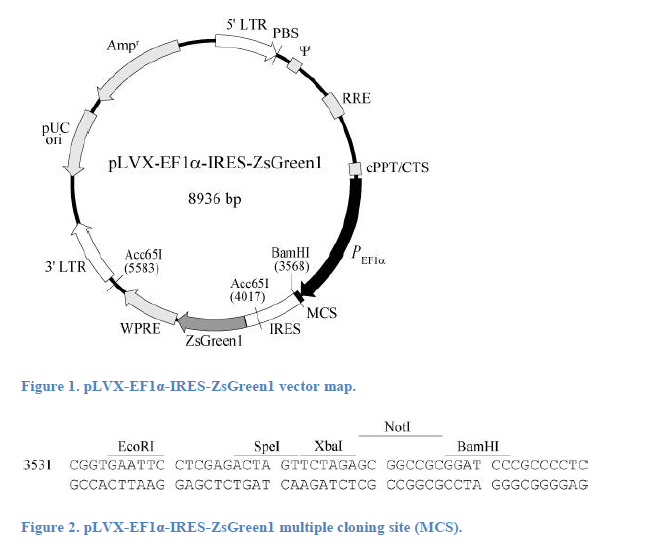
pLVX-EF1α-IRES-ZsGreen1 is an HIV-1-based, lentiviral expression vector designed to simultaneously and constitutively express a protein of interest and the green fluorescent protein ZsGreen1 from a bicistronic transcript in mammalian cells. ZsGreen1 is a human-codon-optimized variant of the reef coral Zoanthus sp. green fluorescent protein (ZsGreen) that has been engineered for brighter fluorescence (1–3). The excitation and emission maxima of native ZsGreen1 are 493 nm and 505 nm, respectively.
Simultaneous expression of a protein of interest and ZsGreen1 is made possible by the presence of an encephalomyo- carditis virus internal ribosome entry site (IRES; 4, 5) positioned between the multiple cloning site (MCS) and the ZsGreen1 gene. The IRES allows a protein of interest and ZsGreen1 to be translated from a single bicistronic mRNA. Stable, constitutive expression of the bicistronic transcript is driven by the EF1α promoter (PEF1α), which continues to be constitutively active even after vector integration into the host cell genome (6).
pLVX-EF1α-IRES-ZsGreen1 contains all of the viral processing elements necessary for the production of replication-incompetent lentivirus, as well as elements to improve viral titer, transgene expression, and overall vector function. The woodchuck hepatitis virus posttranscriptional regulatory element (WPRE) promotes RNA processing events and enhances nuclear export of viral RNA (7), leading to increased viral titers from packaging cells. In addition, the vector includes a Rev-response element (RRE), which further increases viral titers by enhancing the transport of unspliced viral RNA out of the nucleus (9). Finally, pLVX-EF1α-IRES-ZsGreen1 also contains a central polypurine tract/central termination sequence element (cPPT/CTS). During target cell infection, this element creates a central DNA flap that increases nuclear import of the viral genome, resulting in improved vector integration and more efficient transduction (9). The vector also contains a pUC origin of replication and an E. coli ampicillin resistance gene (Ampr) for propagation and selection in bacteria.